Travel Bag Wheel Test: 4 Checks Before Bulk Payment
Wheels are the first part of a travel bag to fail and the last part anyone inspects. A buyer will open a sample, pull the zip, press the base, and sign — then find out in month three that the housing screws were biting into fabric rather than a plate, and that every bag in the container has the same problem. Four checks, run on a loaded bag, will tell you more about a wheeled order than any photograph of the wheel.
The checks below assume a 20 to 25 kg working load, which is what a 55 to 70 cm trolley carries on a real trip, and they are written so the same numbers can be written into a purchase order and re-run at final inspection.
Roll it loaded, on the surface it will actually meet
Load the bag to 20 kg and roll it 4 km on tile or concrete paving. Not carpet: carpet cushions the wheel and hides the two faults that matter, a flat spot from a wheel that locks on turns and a tread that is wearing unevenly because the two wheels are not parallel. Four kilometres is roughly a long airport transfer plus a hotel corridor, and it takes about forty minutes at walking pace.
Then turn. Twenty full circles around a cone at walking pace loads the axle sideways, which is the direction a single-axle wheel is weakest. After the run, look at the tread: even wear across the width is normal, a shiny band on one edge means the wheel is cambered, and a flat patch means it stopped rolling and started skidding.
Drop it, then drag it up a step
Lift the loaded bag 8 cm and drop it onto a hard floor, three times on each wheel pair. Do it on the corner as well as flat, because that is how a bag lands out of a coach hold. Then do the test most buyers skip: put the bag on the floor and drag it up a 15 cm step by the handle. Pulling a loaded bag over a step puts a bending load through the housing that a drop test never reproduces, and it is the single most common way a wheel housing cracks in service.
The pass line is narrow and easy to check: no crack at the housing, the wheel still spins freely by hand, and the axle still looks straight against a steel rule held along the wheel face. A click when the bag rolls after the drop is a crack you have not found yet.
Measure axle play, and check that the wheels are parallel
Lift one side of the bag so a wheel is off the floor, hold the tyre and try to rock it side to side. More than 2 mm of lateral movement at the tyre means the axle hole in the housing is oversize or the axle is a loose fit, and that play turns into a shimmy at walking speed on a smooth airport floor, which is the complaint that gets a bag returned.
Parallel matters as much. Measure the distance between the two wheels at the front of the wheelbase and again at the back; a difference over 5 mm means the bag will track sideways and the user will fight it all the way through the terminal. It also loads one wheel harder, so that wheel wears out first and the other looks new.
How the housing is fixed decides how long it lasts
Three attachments look the same in a photograph and behave nothing alike. Screws through a moulded plate bonded to a rigid base are the durable version. Rivets straight through the shell are acceptable if the shell has a reinforcement patch behind each rivet. Screws that bite into 600D fabric with nothing behind them will pull out, and no amount of thread locking compound changes that.
Ask for the base plate thickness and material: 5 mm of PE or PP under the housing is a working number, and 3 mm flexes enough that the housing rocks with every curb. Then check the fixings by hand on a loaded bag: four screws per housing that stay tight after the roll test are worth more than six that loosen.

Wheel diameter sets the compromise. A 50 mm wheel is quiet and light and catches on every paving joint; a 76 mm wheel rolls over a curb gap without stopping but adds height and weight. For a travel bag built for mixed surfaces, 60 to 70 mm with a PU tread is the usual middle. PU wears slowly and runs quiet; TPR grips better on wet tile and wears faster. Either is a defensible choice, and neither survives a housing screwed into fabric.
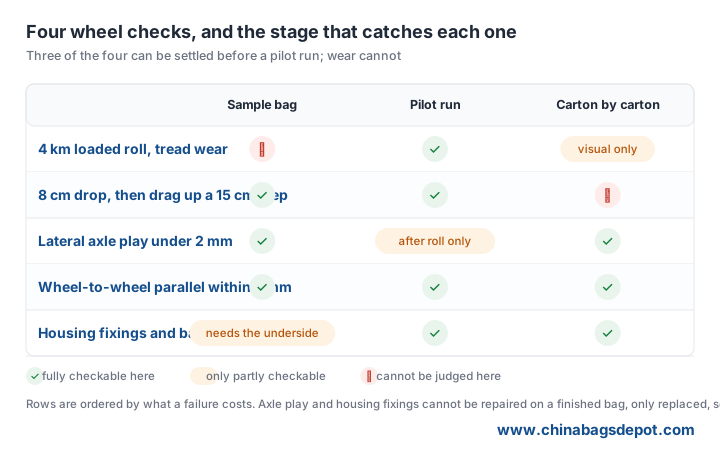
Turn the four checks into five lines on the order
Write them down and the argument ends: wheel diameter and tread material; single or double axle; housing attachment with fixing count and base plate thickness; spare wheels per hundred bags, typically two; and the pass line for lateral play at 2 mm. Five lines, no adjectives, all of them checkable on a sample and again on a carton.
Order the checks by cost. Axle play and housing fixings are cheap to find on a sample and expensive to find in a warehouse, because neither can be repaired — only replaced. Tread wear is the one item that genuinely needs distance, which is why the roll test on a loaded bag belongs in the pilot run rather than in a conversation about the wheel's specifications.
Need custom bags for your next project?
Send your bag style, size and print artwork for a quote and a digital proof.
Get a free quote


