Pencil Case Carton Drop Test: 3 Heights and What They Prove
A carton drop test on pencil cases is usually run to answer the wrong question. Buyers ask whether the pencil case survived; the test actually tells you whether the packaging protected it at the height that carton will really fall from. The same case can pass at 46 cm and fail at 76 cm without the case itself being any worse, because the drop height and the carton weight set the energy the inner packaging has to absorb. This is a protocol for three heights and what to record after each drop.
Why the carton is the object under test
A pencil case in a polybag has almost no structure of its own. A canvas stand-up case relies on its base board and zip to hold shape; a silicone case relies on nothing at all. Both are protected by the carton, the inner box and whatever fills the void between them. When a lot arrives creased or with a broken zip slider, the defect was decided in the packaging specification, not on the sewing line.
That is why the test is run on a sealed, fully packed carton from the production lot rather than on an empty carton or a loose case. Pull three sealed cartons from the run and record carton dimensions, gross weight and unit count before anything is dropped, because a result without those three numbers cannot be compared with a later lot.
The three heights and the handling each one stands for
76 cm stands for single-parcel handling. This is the height a carton reaches when it is sorted on a conveyor, tipped off a chute or thrown into a parcel cage. It is the harshest of the three for light cartons, because a light carton has no mass to resist the impact. If the cases ship as individual parcels rather than on a pallet, this is the height that matters.
61 cm stands for a waist-height drop. A warehouse worker carrying a carton at hip level and losing it produces roughly this impact, and it is the most common real-world case for cartons moved by hand between pallet stacks. It sits in the middle: heavy enough to deform a corner, mild enough that a properly filled carton usually keeps the case intact.
46 cm stands for a two-person floor drop. Heavier cartons get carried by two people and set down hard, or slide off the bottom of a pallet. The drop energy is lower, but the carton weight is higher, so the failure mode changes from carton crush to internal movement: the cases shift inside the void and the zip or the case corner takes a local hit.
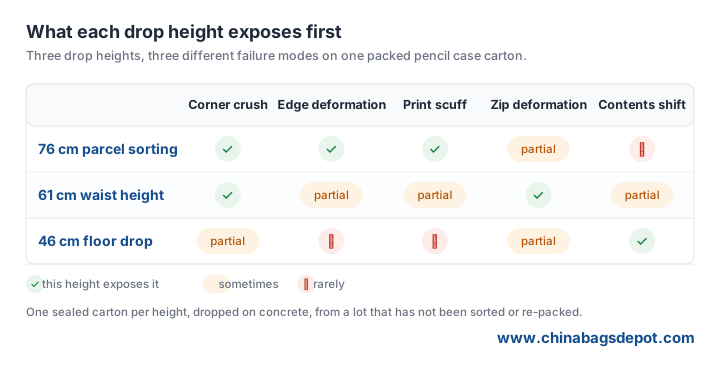
Those three tiers track the weight bands used in published drop-test schedules, where the drop height falls as package weight rises. Check the exact heights and the number of drops against the current text of the standard you are buying to, because the bands are revised and a quotation that names a standard without a revision year is not a specification. The published schedules also assume a rigid floor: a drop onto a pallet or a rubber mat is not the same test, so state concrete.
How to run the drops so the result means something
Use one carton per height so a failure at 76 cm cannot hide damage carried from an earlier drop. The drop sequence that gives repeatable results is the standard ten-drop pattern: one corner, the three edges radiating from that corner, then the six faces. Mark each face with a number before the first drop so the report can say which one failed.
Hold the carton so the struck face is parallel to the floor, release without pushing or throwing, and let it fall freely. Reset and inspect between drops rather than at the end, because a corner that collapsed on drop three explains the scuff found after drop eight.
What to check after each drop
Inspect in a fixed order: carton corner and edge deformation, then the carton score lines, then the inner box, then the cases themselves, then the contents.
On the case, check four things. Whether the base board still sits flat, since a bent base board makes a stand-up case lean forever. Whether the zip runs its full length without catching, because a deformed case body pinches the zip tape. Whether the print is scuffed at the corners, which is where abrasion always shows first. And whether a silicone or EVA shell has cracked at the seam, which appears as a white line along the moulded edge.
Check the contents. Pens and rulers add mass and their own corners; a case that passes empty will fail with a full load. Pack the cartons exactly as the bulk order will ship, including any insert card, dust bag or retail hangtag.

Where the failures actually come from
Almost every drop failure traces back to one of three packaging decisions rather than to the case. The first is void fill: a carton with 20 mm of free space on any face lets the contents accelerate before they hit the wall. The second is inner box grade, where a single-wall box is asked to do the work of a double-wall one. The third is unit orientation, packing cases flat and stacked so that the corner impact loads the zip edge instead of a flat panel.
Two fixes solve most of it: reduce the carton to the actual packed volume so there is no travel gap, and add a corrugated pad at the two faces that receive the corner and edge drops. If the carton still fails at 76 cm, the honest answer is usually a heavier board rather than more tape.
What the report should contain
Write the carton dimensions, gross weight, unit count and the drop height used; list the ten drop positions in order; state pass or fail per check with a photograph of each defect; and name the packaging changes made between the first and the passing run. A report without the height and carton weight cannot be compared with the next lot, and comparison is the whole point.
Browse the pencil case range to see which constructions need a heavier carton, then send us the packed weight and the shipping mode you use and we will propose the carton and inner packaging that pass at the height your channel actually applies.
Need custom bags for your next project?
Send your bag style, size and print artwork for a quote and a digital proof.
Get a free quote


