PU Handbag Peeling: 3 Tests That Predict Returns
PU handbags rarely wear out. They let go. The polyurethane coating loses adhesion at a crease or a cut edge, lifts in sheets and takes the colour with it, and the customer photographs it in month four and asks for a refund. By then the container is long gone and the whole run carries the risk.
The failure is predictable on a sample. Three bench tests — a fold and roll, a cross-hatch tape pull and a sweat rub — take about an hour per bag and separate a coating that will hold from one that will not, before the purchase order is signed.
Peeling is an adhesion failure, not a wear failure
PU is a coating, not a material. A woven or knit base carries a polyurethane layer, sometimes with a release paper texture pressed into it, and the bond between the two is the whole product. When it fails, the mechanism is one of three: hydrolysis in warm humid air, flex fatigue at a crease, or contamination at the interface from mould release agent or too little primer.
That matters for how you test. Abrasion tests tell you how the surface resists rubbing, which is a retail-shelf question. They say nothing about whether the coating is still attached after a month in a warehouse, which is the returns question. The three tests below attack adhesion and colour, not scuff resistance.
Two practical notes before you start. Take samples from at least three places on the bag — the flap, the gusset and a strap — because coating thickness varies across a panel and the thin end is where peeling begins. And test the finished bag, not a swatch: the heat and pressure of the seam and the edge fold change the coating's behaviour at exactly the points that fail first.
Test one: fold and roll the crease
Fold the panel coating-side out along the crease line the bag will actually see, put a 1 kg roller across the fold, and run it back and forth ten times. Unfold and look at the crease under a raking light.
White crazing that fades when you rub it with a thumb is surface stress and usually survives. A visible crack that stays, or a crease where the colour has gone milky and the film looks separated from the weave, is the failure you are looking for. Repeat the fold at the gusset, where a bag flexes every time it opens, and at the strap root, where the coating is stretched over a curve.
For a figure to hold the supplier to, ask what flex cycle count their coating is rated for and then run a fifth of it: if they claim 20,000 double folds, put a sample on a flex tester for 4,000 and see where crazing starts. The number in the specification is negotiable; the crease in front of you is not.
Test two: cross-hatch and pull tape
Cut a lattice of six parallel lines in each direction, 2 mm apart, through the coating to the base, then press adhesive tape over it, rub it down and pull at 60 degrees in one movement. This is the ISO 2409 method, the same one the paint industry uses, and its rating scale runs from class 0, no coating removed, to class 5, most of the lattice gone.

Use 2 mm spacing rather than 1 mm, because a bag panel is a soft substrate and 1 mm cuts tend to tear the base instead of the coating. Read the result by area, not by eye-level impression: class 0 or 1 passes, class 2 is a warning, class 3 and above is a coating that will lift at the first edge that gets rubbed.
Run the cut on the handbag panel where the coating has been folded over an edge, and again on a flat area. A sample that rates 0 flat and 3 on the fold is telling you the edge is not primed before folding, which is a factory process fix rather than a material change, and it is worth saying so in the same email as the sample photos.
Test three: sweat, then rub
PU softens with heat and salts, and a strap sits against a palm all day. Wet a white cotton cloth with artificial perspiration — the acid and alkaline solutions in ISO 105-E04 are the standard pair — press it on the panel under a 1 kg weight for four hours at 37 °C, then rub the same spot with fresh white cotton for twenty double strokes.
Two readings come out of it. Colour transfer onto the white cloth, graded against the grey scale: 4 or above is a pass for a dark bag, 3 is visible on a light shirt. And coating condition afterwards: if the film has gone tacky or lifted at the edge of the wet patch, humidity is the bag's real enemy and the shipping carton needs desiccant, not just better foam.
A cheaper version of the same test, when the lab is not available: a 0.5 percent salt solution at body temperature, one hour, then the rub. It will not give you a grade to quote, but it will tell you within an hour whether a black PU strap is going to leave a mark on a white shirt in August.
Reading the three results together
No single test condemns a bag on its own, and a sample that fails all three is not a negotiation, it is a different supplier. What the trio gives you is a diagnosis: folding failures point at coating flexibility, tape failures point at primer and adhesion, sweat failures point at the topcoat and the pigment.
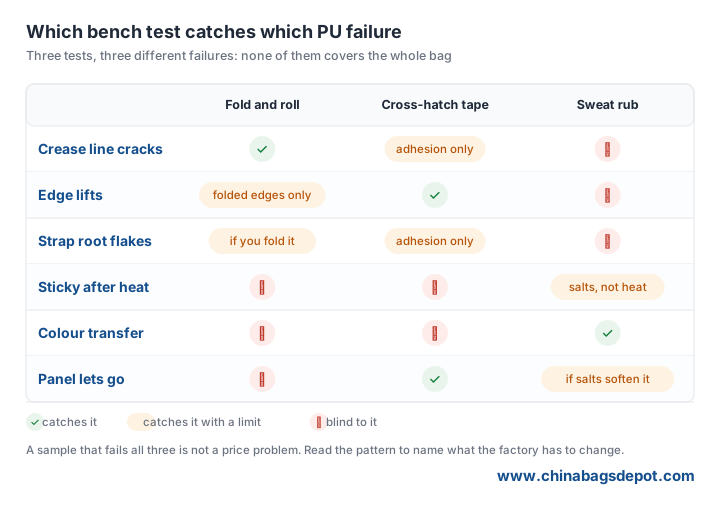
Write the results into the purchase order as three lines — adhesion class from the cross-hatch, flex figure and where crazing started, colour transfer grade after the sweat rub — and add the storage instruction that comes with them: keep the cartons out of direct sun and below 25 °C before shipment, because a coating that passes on the bench can still hydrolyse in a hot container. Those four lines are the difference between a bag that survives a season and a returns folder full of photographs.
Need custom bags for your next project?
Send your bag style, size and print artwork for a quote and a digital proof.
Get a free quote


