School Backpack Safety Specs: 5 Standards for EU and US Buyers
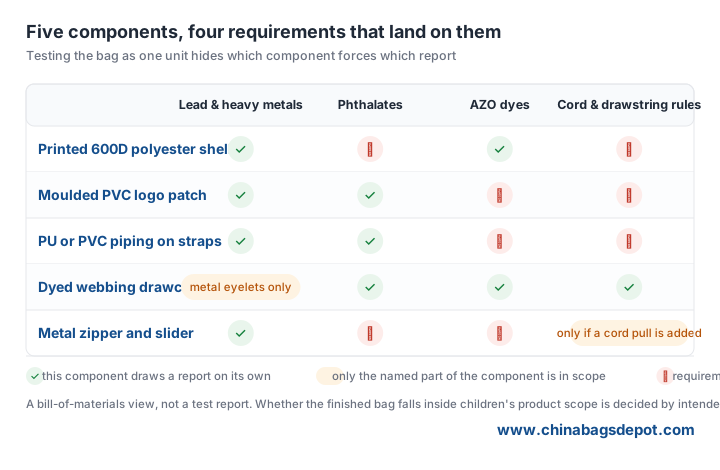
Most school backpack compliance problems start before any testing happens: the buyer assembles a bag from five components and assumes one test report covers it. It does not. A report is written against a specific bill of materials, so a printed polyester body, a PVC patch, a dyed webbing drawcord and a metal zipper each pull a different set of requirements, and swapping any one of them quietly voids the paperwork you paid for.
Here are the five checks worth running on the spec sheet and the sample, in the order that a failed check costs the most to fix.
First decide whether the bag is a children's product at all
Scope decides everything downstream. Under the US framework, a children's product is one designed or intended primarily for children twelve and under, and that intent is judged from packaging, marketing, age labelling and how the item is commonly recognised — not from what the factory calls it. A backpack sold as school supply for ages six to ten sits inside that scope and needs third-party testing by an accepted lab before it can be certified. A laptop sleeve marketed to commuters does not.
Write the intended age range on the purchase order and keep it consistent with the hangtag, the listing and the artwork. Inconsistent age claims are the single most common reason a shipment gets held: the same bag is described as a youth product in the catalogue and an adult accessory on the invoice, and the importer has to prove which one it is.
Lead and heavy metals, by component
The number buyers quote is 100 ppm total lead in accessible substrate, with 90 ppm for paint and surface coatings. Those limits are easy to pass in the body fabric and easy to fail in the parts nobody samples: brass-effect zipper sliders, printed plastisol on a dark ground, cheap metal rivets, and the coloured coating on a buckle.
Practical handling is to build the test plan from the bill of materials rather than from the finished bag. List every component that a child can touch, mark the material and the colour, and sample each one. An XRF gun in the sample room will screen metal and coated parts in seconds and tell you which pieces deserve a lab report; it is a screening instrument, not evidence, so the parts it flags still need wet chemistry.
Phthalates live in the soft trim, not the fabric
The restricted phthalates are limited to 0.1 percent each in children's toys and child care articles, and buyers routinely extend the same limit to school bags as a condition of purchase. The risk sits in plasticised PVC: moulded logos, reflective patches, piping, printed transfers and the soft grip on a zipper pull. Plain woven polyester and uncoated nylon are not the problem.
Two decisions remove most of the risk. Specify phthalate-free plasticiser for any PVC component in writing, and ask for the component supplier's declaration rather than accepting a finished-goods report that lists only "PVC trim". If a moulded patch is decorative and could be replaced by embroidery or a silicone label, replacing it is often cheaper than testing it every season.
Drawstrings and cords: the check that gets bags recalled
Cord rules are where bags fail most often, because they are a design decision made in the artwork stage and almost impossible to fix after cutting. In the US, the reference for children's upper outerwear is ASTM F1816, which removes drawstrings from the hood and neck area entirely for the sizes it covers. In the EU, EN 14682 governs cords and drawstrings on children's clothing, and buyers commonly apply it to backpack straps and hood cords by analogy: no free ends longer than 75 mm in the hood and neck area, no toggles, knots or attachments at cord ends, and no cords that can form a loop when the bag is worn.
Applied to a backpack, that means the shoulder straps should carry no loose adjustment tail long enough to catch, the top handle should be a fixed loop of correct dimensions rather than an adjustable cord, and any bungee on the front panel should be short, elastic and terminated without a plastic toggle. Measure the free ends on the sealed sample with a steel rule and record the numbers; "short enough" is not a specification.

Small parts, sharp points and hardware that comes off
Even where a bag is not a toy, the reference most labs still use for detachable pieces is the small-parts cylinder from 16 CFR 1501, and for edges and points the sharp-edge and sharp-point test methods from 16 CFR 1500.48 and 1500.49. The failure mode is not the test itself but the assembly: a decorative lock, a badge or a zipper pull held by a single stitch line will detach under a pull that a child can generate without trying.
Ask the factory what holds each attached part and for how many stitches. A zipper pull threaded through the slider and bar-tacked, a decorative lock riveted through a reinforced panel, and a badge sewn on four sides will all survive a pull test that a tacked-on badge will not. Test five pieces from the pilot run, not one from the sample room, because the assembly step is where the process drifts.
What the paperwork has to say
A test report is only usable if its sample description matches your bill of materials: component list, colour, material and construction. Check that the report names the lab, the standard and its version, the date, and the specific parts tested. A report that describes "school bag, assorted" against a bag you have since changed the trim on is not evidence of anything, and re-testing is cheaper than a customs hold.
Set a retest trigger in writing: any change of shell fabric, coating, trim supplier, print method or metal-plated part requires a new report on that component before the next shipment. Then keep one folder per style with the report, the bill of materials it was written against, and the sealed sample that was tested. When a buyer asks a question two seasons later, that folder answers it. The school backpacks category shows the range of constructions these checks have to cover.
Need custom bags for your next project?
Send your bag style, size and print artwork for a quote and a digital proof.
Get a free quote


