Pencil Case Bulk Order: 6 Closure and Lining Specs
A pencil case looks like the easiest item in a stationery programme and behaves like the hardest to reorder. The reason is that almost every decision is hidden inside the closure: a zip that runs smoothly in the sample can stick on a full case in week three, and a lining that looks clean under office light can show every pencil mark by the end of a school term. Buyers who lock six specs before the sample is approved rarely come back with a complaint; buyers who approve on appearance alone usually do.
This guide walks through the six specs that decide whether a 3,000-piece pencil case order arrives usable, and how to write each one so the factory has no room to interpret.

1. Closure type, tested shut
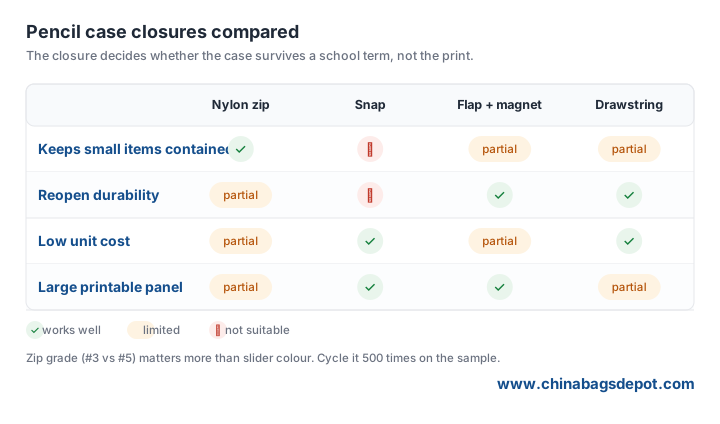
There are four options in practice: a nylon zip, a single snap, a flap with a magnetic closure, and a drawstring. A zip is the only one that keeps small items contained when the case is dropped, and it is the only one that can fail in a way that makes the product unusable. Specify the zip by tape width and slider type, not just by colour: a #3 nylon coil is standard for a 21 cm case, and a #5 is worth the small premium if the case will be opened several times a day. Ask the factory to cycle the zip 500 times on the sample before you approve it. If it catches, the fix is the slider, not the tape.
2. Lining fabric and colour
The lining decides how the case ages. A 210D polyester lining is light, cheap and shows graphite within a month. A 420D is heavier, holds its shape and hides marks far better at a small cost difference. Black or dark navy lining hides pencil dust; white or pale pink looks better in a photograph and worse in a bag. Ask for the lining weight in denier, and ask for a sample in the actual colour rather than a swatch card — lining colour shifts noticeably between dye lots.
3. Internal structure
Single compartment, two compartments, or an elastic loop panel. The elastic panel adds value for a school order and about 8 to 12 percent to unit cost. If you choose it, specify the number of loops and the elastic width, because a 10 mm elastic cut to 40 mm loops will sag under a pen within weeks. A two-compartment case needs a centre divider stitched top and bottom; a divider stitched only at the sides will flop open and let items cross over.
4. Stitching and edge finish
Look at the case inside out before you look at the front. Stitch density should be 8 to 10 stitches per inch on the seams, with backstitching at both ends of every stress line. Seams that meet the zip should be bound or overlocked; a raw seam will fray and drop threads into the case. If the case has piping, check that the piping cord does not pull out at the corners — a common failure that only appears after a few hundred opens.
5. Print method and placement
Screen print is the default for a one to three colour logo on a flat panel and stays sharp at 3,000 pieces. Heat transfer suits photographic artwork but can peel at the edges on a textured fabric. Embroidery works on canvas and denim cases and carries a setup cost per design. Whatever the method, specify the print area in millimetres from the panel edge, not as a percentage of the case — otherwise the placement shifts with the size grade. Allow a 3 mm tolerance and write it into the approval sheet.
6. Size grades and pack-out
A school order usually needs two or three sizes. Specify each size explicitly with the finished dimensions, and confirm whether the print artwork scales or stays at a fixed size across grades. Then agree the pack-out: pieces per polybag, polybags per inner carton, inner cartons per export carton. A pencil case is light but bulky, so the carton is often volume-limited rather than weight-limited, and the pack-out is what determines your freight. Ten pieces per polybag with a header card usually beats individual polybags on both cost and protection.
What to put on the approval sheet
Six lines, one photograph each, signed before production: zip brand and slider type, lining denier and colour, loop count and elastic width, stitch density, print area in millimetres, and pack-out. Add the 500-cycle zip test result. That sheet is what the factory will work to and what your inspector will check against. Our pencil bag range covers zip, flap and drawstring constructions; a standard single-compartment zip case or the larger child-size printed case can both be quoted with these six specs already fixed, which removes most of the back-and-forth before sampling.
Need custom bags for your next project?
Send your bag style, size and print artwork for a quote and a digital proof.
Get a free quote


