Pencil Case Bulk Order Spec Sheet: 7 Fields Buyers Forget
A pencil case order usually goes wrong in the same place: the spec sheet has a sketch and a quantity, and the seven fields that decide how the sample is cut, sewn and packed are left to the factory to interpret. The result is a first sample that looks close and measures wrong, or a second sample that costs a new set of screens because the print placement moved. Each of the seven fields below is cheap to write and expensive to leave blank.
Why These Fields Decide the Price
A pencil case is a small sewn item with a short pattern and a high labour share, which means the cost sits in the cutting, the zip and the print setup rather than in the fabric. Anything that changes the pattern changes the cutting; anything that changes the print size changes the screens. Factories quote from the spec, so an ambiguous spec produces a quote that is either padded to cover the risk or low enough to win the order and later revised. Writing the seven fields costs an hour and removes both outcomes.
Fields 1 to 3: Size, Fill Capacity and Substrate
- Finished size and tolerance. Give length, width and depth in millimetres and state whether they are measured flat or filled. A 20 mm depth on a flat bag becomes 15 mm once a full set of pens is inside, and a case that will not close is a rework, not a tolerance argument. Ask for plus or minus 3 mm on sewn goods and put it in writing.
- Fill capacity. Name what has to fit: a 30 cm ruler, a 15 cm ruler plus a calculator, an A5 notebook, a 24-colour pencil set. Capacity is what the buyer actually tests, and it is the field most often replaced by a photo of a similar bag.
- Substrate and weight. 600D polyester, 12 oz canvas, silicone, felt and PU each behave differently at the seam: canvas frays, silicone stretches, felt pills. Name the material, the weight or thickness, and the colour reference. If a recycled or organic claim matters, put the certificate name in the spec rather than in the marketing copy.
Fields 4 and 5: Zip and Print
The zip is the most common single point of failure on a low-cost case, and it is also the easiest item to specify precisely. Write the tape type, the chain size (a #5 nylon coil is heavier than a #3), the length in millimetres, whether it is closed-end or two-way, and whether a branded slider is required. A slider change alone can move the unit cost, so it belongs in the quote request rather than in a later email.
Print is the other half of the same problem. Screen printing on a flat panel is the cheapest route and needs the artwork sized to the panel, not to the bag. Heat transfer wraps seams and curves but needs a higher setup. Embroidery adds weight and cannot reproduce small type. Whatever the route, give the placement box as a measurement from a named reference point, supply Pantone references for each colour, and say how many colours the artwork uses, because each colour is a separate pass and a separate cost.

Fields 6 and 7: Lining, Pockets and Packing
Inside the case, the difference between one compartment and a lined interior with elastic loops is a different pattern, a different labour time and a different sample. Say whether the lining is required, what it is made of, and where the pockets go with dimensions. For school and promotional orders, an elastic loop strip sized to a specific pencil count is often the feature that decides whether the case is used or thrown in a drawer.
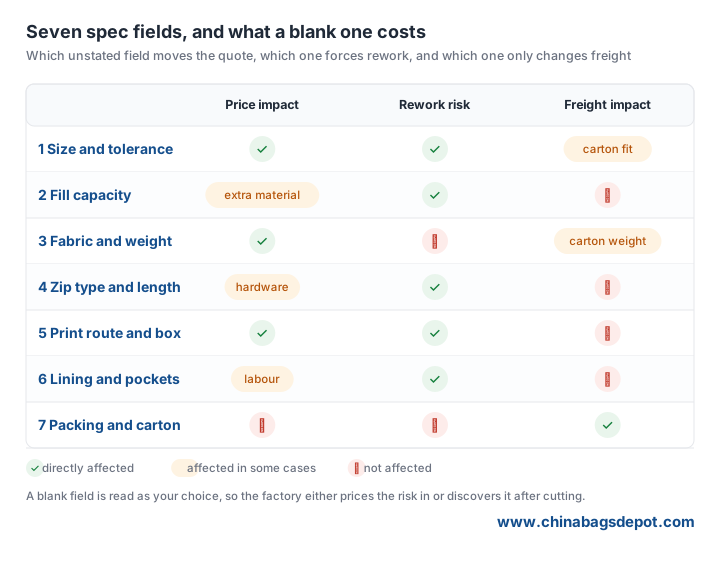
Packing is the field buyers forget because it feels like logistics rather than product. It decides the master carton size, and the carton size decides the freight. Write the individual poly bag or hangtag, the number of pieces per inner box and per master carton, and the maximum carton weight you will accept. On a small, light item the carton is often volume-limited rather than weight-limited, so the number of pieces per carton is a cost decision disguised as a packing note.
How to Write the Sheet So Nothing Is Guessed
Format matters as much as content. Use a table with one row per field, a column for the value and a column for the tolerance or acceptable alternative. Reference a photo for every field that describes a shape, and number the revision so the factory quotes from revision 3 rather than from whichever file was emailed last. Where a value is genuinely flexible, write the range instead of leaving the cell empty: a blank cell reads as your choice, a range reads as a decision.
Then add two lines that turn the sheet into a quality document: the inspection level for the pre-shipment check, and the sample approval rule. If the approved sample is the reference, keep one signed copy with the order and one with the factory, and note the date on both.
Sign-Off Before the Bulk Run
When the sample arrives, check it against the sheet rather than against memory. Measure the three dimensions flat and filled. Load the case with the items named in the fill field. Zip and unzip it twenty times and look at the tape ends. Compare the print placement to the box you wrote, with a ruler. Confirm the carton quantity and weight by weighing one master carton. Five checks catch nearly every mismatch that would otherwise be found by the end user, and each one maps to a field you already wrote.
Send the seven fields with your quantity and target market, and we will come back with a quote that separates the material, the print setup and the carton plan, plus a sample schedule. Browse the pencil bag range to pick the construction before the sheet is written.
Need custom bags for your next project?
Send your bag style, size and print artwork for a quote and a digital proof.
Get a free quote


