REACH and Prop 65 for Bags: 5 Documents to Request
There is no such thing as a REACH certificate. REACH is a regulation with a restricted-substances list and a candidate list that changes, and what a buyer receives is a set of test reports and declarations that either cover the bag you ordered or quietly do not. The gap between those two outcomes is almost never the lab's chemistry; it is which materials, colourways and components the sample request named. Five documents close most of that gap, and the same five are the ones a European retailer or a California importer will ask for when the shipment is already on the water.
Start with what the regulation actually requires
REACH obligations split into two different jobs, and buyers conflate them. Annex XVII sets concentration limits for named substances, so a report shows a number against a limit. The candidate list of substances of very high concern works differently: above 0.1 percent by weight in an article, the obligation is communication, and the supplier has to declare it rather than fail it. A pack that treats both as pass-or-fail will reject a bag for containing a declared substance at a level that is entirely legal, and will accept a bag whose report predates the last candidate list update.
Proposition 65 sits on a third footing again. It does not ban anything; it requires a clear and reasonable warning before a California consumer is exposed to a listed chemical. That makes the Prop 65 document a decision record, not a certificate, and a supplier who sends a page headed "Prop 65 compliant" has sent you nothing you can defend.
Document one: an SVHC screen against a dated list
Ask for a screening report that names the candidate list revision it was tested against, and check that date against the report date. The list is amended at intervals through the year, so a screen run two years ago is a screen against a shorter list. The report should also state the threshold used, which for an article is 0.1 percent by weight per homogeneous material, not per bag. That distinction matters on hardware: a zinc alloy buckle is one homogeneous material and its plating is another, so averaging the two hides a concentration the plating alone would exceed.
Pair the report with an Article 33 declaration covering the bill of materials, because screening tests target a list of analytes and a declaration covers the materials. If neither mentions the lining, the thread or the edge paint, assume none of them was assessed.
Document two: the Annex XVII numbers that decide bags
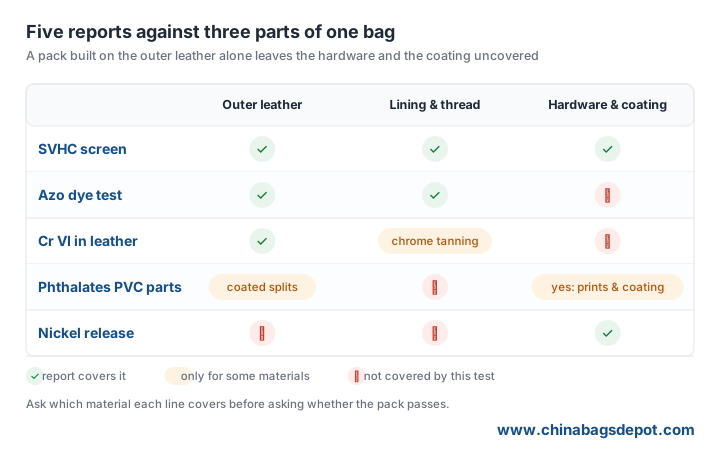
Four entries do most of the work on a leather or coated-fabric bag. Azo dyes that cleave to aromatic amines are limited to 30 mg/kg in the finished article. Chromium VI in leather is limited to 3 mg/kg, and this is the entry most likely to fail on a chrome-tanned hide, particularly one finished in a hurry or stored damp. Phthalates in plasticised material are limited to 0.1 percent by weight for the named esters, which catches PVC trims, printed panels and coated splits rather than the leather itself. Nickel release from articles in prolonged skin contact is limited to 0.5 micrograms per square centimetre per week, measured by the release test rather than by a total-content test.
Each of those is a number against a limit, so each needs the material named next to it. A report showing chromium at 1.8 mg/kg is good news for the hide it tested and silent about the second colourway dyed in a different drum.

Document three: a Prop 65 assessment with the warning decision written down
What you want is a document that lists the listed chemicals screened for, the detection limits, and the conclusion: either the exposure falls below the relevant maximum allowable dose level, or a warning is supplied. Lead is the usual driver, and the arithmetic is unforgiving because the maximum allowable dose level for lead is a fraction of a microgram per day. A component that reads 90 ppm total lead can still pass a screening threshold and still leave a warning obligation unresolved, so ask for the exposure reasoning rather than a single number against 100 ppm.
Plasticiser migration from a printed panel and cadmium in cheap metal trim are the other common findings. If the answer is a warning label, get the exact wording and the placement agreed before the hangtags are printed, because reprinting tags after the fact costs more than the testing did.
Documents four and five: the material breakdown and the chain behind the report
The fourth document is a bill of materials decomposed to homogeneous materials: outer leather, lining, interlining, thread, edge paint, adhesive, zipper tape, metal hardware, plating and any print. Each line carries its material and its supplier. Without it, no test plan can be priced and no report can be matched to a bag. Ask for it as a spreadsheet with colourway codes; your compliance team will need to keep that file.
The fifth is the validity chain: the laboratory's accreditation for the specific methods used, the sample photographs with the colourway code visible, and a statement that the sample tested is the production specification. A report from a laboratory without accreditation to the relevant method, or one whose sample photo shows a different colour from the PO, gets returned by every serious retailer regardless of the numbers inside it.
Why packs come back, and the five-line fix
The rejections repeat. The report covers one colourway and the order has four. The candidate list revision is older than the shipment. The sample named in the report is a stock item rather than the SKU. The lab held no accreditation for the method. The metal hardware was excluded because it was bought in from a third supplier. All five are paperwork failures, and all five are visible before the deposit is paid.
The fix is a single page sent with the enquiry: five lines naming the reports required, the materials each must cover, the colourways, the acceptance numbers for azo, chromium VI, phthalates and nickel release, and the date by which the pack must be current. Suppliers quote differently once that page exists, and the ones who answer it in a week usually built their leather handbag range for export.
Need custom bags for your next project?
Send your bag style, size and print artwork for a quote and a digital proof.
Get a free quote


