Satchel Price Breaks: 300 vs 1,000 vs 3,000 Units
Three satchel quotes arrive — 300, 1,000 and 3,000 pieces — and the unit price does not fall in a straight line. It drops sharply, then flattens, then drops again. That shape is not sales strategy. Each drop marks a fixed cost that stopped being spread over your order and started being paid once, and once you can name the cost behind each step you can decide whether the quantity is worth chasing or whether the specification should change instead.
Everything below assumes the same satchel: same pattern, material, hardware and packaging. A break you did not ask for usually means a specification changed quietly, so keep the sample in front of you.
The three lines that create every price break
A sewn bag has three costs that do not scale with quantity. The first is setup: pattern grading, cutting-program preparation, and the time a line spends being rebuilt for your style. The second is the buy: handle rings, buckles, feet, zips and lining are purchased in minimum packs or minimum dye lots, not by the piece. The third is print and packaging: a logo on the lining, a debossed patch, a printed carton, each with a plate or a die behind it.
Do the arithmetic once and the whole curve becomes obvious. Take a fixed cost of 1,500 in your currency — a print plate plus a die, a dye-lot premium, a grading charge. Spread across 300 bags it adds 5 per bag. Spread across 3,000 it adds 0.5. Nothing about the bag improved; the same money is simply divided by ten times as many units. Every step on a satchel price ladder is that division, applied to a different line.
At 300 units you are paying for setup, not for leather
Three hundred satchels is a sample-run quantity. The cutting table is where it hurts: a satchel has a front panel, a gusset, a flap, a back panel and two straps, and the layout that nests those pieces efficiently needs a longer run to fill the hide or the roll. At 300 pieces the cutter works with a layout that leaves more waste per bag, and that waste is invisible in the quote — it is inside the material price.
Colour is the second penalty. Three hundred units in three colours means three short runs of 100, and material suppliers sell by the roll or the dye lot. If the colour is a stock line you can split the run and absorb it; if it is custom, the mill minimum usually swallows the small quantity and the price per bag reflects a roll you cannot use up. That is the most common reason a 300-piece quote looks unreasonable: the material buy set the number, not the sewing line.

Between 300 and 1,000, the layout and the buy change
One thousand pieces is the first quantity where the efficient cutting layout pays for itself. The cutter can nest the pattern across the full width of the material, and the waste per bag approaches the layout's theoretical minimum rather than being whatever fits. On a satchel, the difference between a tight and a loose layout is usually a visible percentage of the material cost, and at 1,000 pieces it is worth asking the supplier to show you the marker — the drawing of how the pieces are placed on the material. A supplier who has a marker for your style will send it.
The second change is the hardware buy. At 1,000 pieces, handle rings, feet and buckles can be ordered in your finish instead of taken from stock, and the lining can be dyed or printed to your reference rather than chosen from a card. Ask specifically which components will be bought to order at 1,000 and which stay stock; the answer tells you where the remaining fixed costs sit and what the next step will unlock.
What 3,000 units actually buys
At 3,000 the setup costs have almost vanished per unit, so the remaining differences are in purchasing power and in packaging. Hardware moves to a dedicated order in your finish, which also secures the finish for a reorder. Cartons can be printed with your artwork instead of carrying a generic stamp, and the export mark can be printed instead of labelled, a plate worth paying for only at volume.
This is also the quantity where a second colour becomes nearly free in setup terms. If your 3,000 is split across three colours at 1,000 each, you are effectively buying three 1,000-piece runs; the break you were quoted for 3,000 assumes one colour. Ask for both prices before you commit, because a multi-colour 3,000 is often quoted at the single-colour 3,000 rate by mistake, and the error surfaces at the material order.
Read the break before you accept it
Four checks turn a price ladder into a decision. First, confirm the specification is identical across all three quotes: same material thickness, same lining, same hardware finish, same packaging. Second, confirm the incoterm and the port, because a break can come from a change in shipping terms rather than from the factory. Third, confirm the payment terms — a 30 percent deposit on 3,000 pieces is a different cash commitment, and some suppliers price the difference in. Fourth, ask what happens to the tooling or plate cost if you reorder; if it is charged again, the break was smaller than it looked.
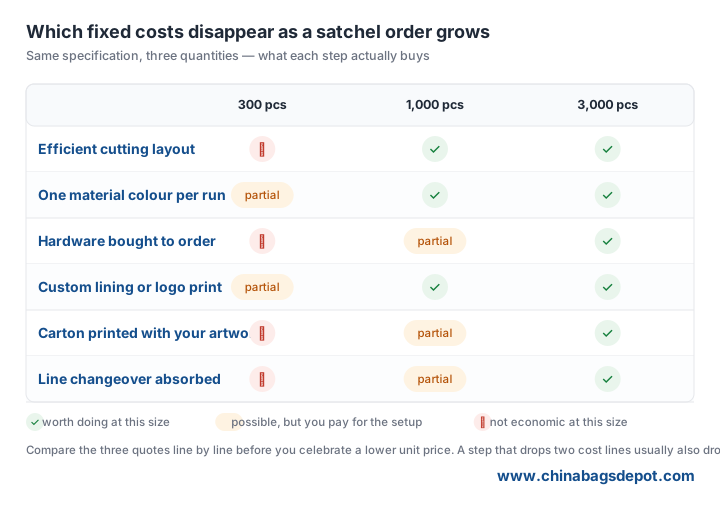
The matrix is the short version: cutting layout and single-colour running are the 1,000-piece unlocks, while hardware to order, printed cartons and an absorbed changeover wait for 3,000. If your budget only reaches 1,000, the useful move is not to argue the price down but to simplify the specification — one colour, stock hardware, plain carton — so the fixed costs you are still paying for are the ones that show on the bag. Buyers who chase the 3,000-piece price at 1,000 units almost always get it by removing something from the product, and the carton they receive proves it. See the full satchel range for the pattern and hardware options that set these cost lines.
Need custom bags for your next project?
Send your bag style, size and print artwork for a quote and a digital proof.
Get a free quote


