Pencil Case MOQ Explained: 4 Cost Lines That Set Your Minimum
A pencil case minimum is rarely one number the factory invented. It is the highest of four separate floors, and which one is highest changes with the design. A plain canvas case with a single-colour print and a stock poly bag can often run at a few hundred pieces; add a second print colour, a custom header card and a branded zip pull, and the same case jumps to a thousand. Ask for the four lines separately and the quote stops being a take-it-or-leave-it figure.
Where a pencil case minimum actually comes from
Four cost lines set a floor: fabric and lining, cutting and sewing time, print or embroidery setup, and packaging. Two of them are fixed per order, which means they get cheaper per unit as the order grows and become punitive when it shrinks. The other two scale with quantity and do not care how big the order is.
The practical move is to ask which line is forcing the minimum up, then treat that line as a design problem. That line is the one worth redesigning, and it is almost never the fabric. The same four lines apply to every style in the pencil bag range.
Line one: fabric, lining and the minimum cut length
Mills sell by the roll or by a minimum cut length, and a 600D polyester or cotton canvas is commonly sold in a colour in lengths of tens of metres rather than single metres. Divide that minimum by the consumption per piece and you get a fabric-driven MOQ. A small zip case cut from 1.5 metre wide goods typically consumes somewhere between 0.15 and 0.25 metres per piece once the pattern is nested, so a 50 metre minimum on one colour works out at a few hundred pieces before any other line is considered.
This is why a two-colour body costs more at small quantities than a one-colour body: it is not the fabric price, it is that you now need a minimum cut in two colours instead of one. Using a stock colour the factory already holds removes that floor entirely.

Line two: cutting and sewing time, the least rigid floor
Labour is paid per piece, so sewing does not set a minimum in the way tooling does. What sets it is line balancing: a factory that runs a twenty-operator line needs enough work to keep that line fed for a shift, and a pencil case with a standard minute value of three to six minutes is a small unit of work. A few hundred pieces will not hold a line, so the scheduler either puts the order behind a bigger one or quotes a price that makes it worth interrupting production.
Cutting is where a real choice appears. A steel rule die costs money once and then cuts a stack of layers in one stroke, which is fast and consistent but only pays back over volume. Hand cutting or a hot knife avoids the die charge entirely and is the right call under a few hundred pieces, at the cost of slower work and slightly more variation in the seam allowance. Ask which method the price assumes; that explains why two quotes for one case differ.
Line three: print setup, screens and the per-colour step
Screen printing charges per colour, twice over: once for the screen itself, and once per pass through the dryer. A one-colour logo means one screen and one pass; a four-colour design means four of each, and the setup element is written off across the order. That is the arithmetic behind the familiar rule of a few hundred pieces per colour, per design.
There are two ways around it. Heat transfer or digital film printing removes the screen charge, at a higher cost per piece and with slightly softer edges on fine detail. Alternatively, keep the artwork to one colour and place it in a position that does not need a second pass, such as a single hit on the front panel. Embroidery behaves the same way: the digitising file is a one-off charge fixed by stitch count, then each piece costs machine time across however many heads the machine carries.
Line four: moulds, packaging and carton fill
Silicone and moulded EVA cases are the one category where tooling genuinely dominates. A compression or injection mould is a real capital item and the factory will not open one for a few hundred pieces, which is why moulded cases usually start an order of magnitude higher than sewn ones. If the design can be sewn, the mould disappears from the quote.
Packaging has a quieter floor. Printed header cards, printed poly bags and custom boxes are printed in runs, so their minimum is a print minimum, not a sewing minimum. Carton fill matters too: a carton that holds 100 pieces shipped with 80 in it adds nothing to the goods cost but raises freight and handling per unit, and a 280 piece order against a 100 piece carton leaves three part-filled cartons. Quote the case quantity against the carton quantity before you fix the order size.
Turning the four lines into a quote you can compare
Ask for the breakdown in four rows, each marked fixed or variable, and ask which row is currently the binding constraint. Then test it: request a price at half the quantity and at double it. A line that is genuinely fixed will show a large unit swing between the two, and a line that is variable will barely move. The row that swings hardest is where the negotiation sits, and the fix is usually one of three things: a stock colour instead of a dyed one, one print colour instead of three, or stock packaging instead of a printed header card.
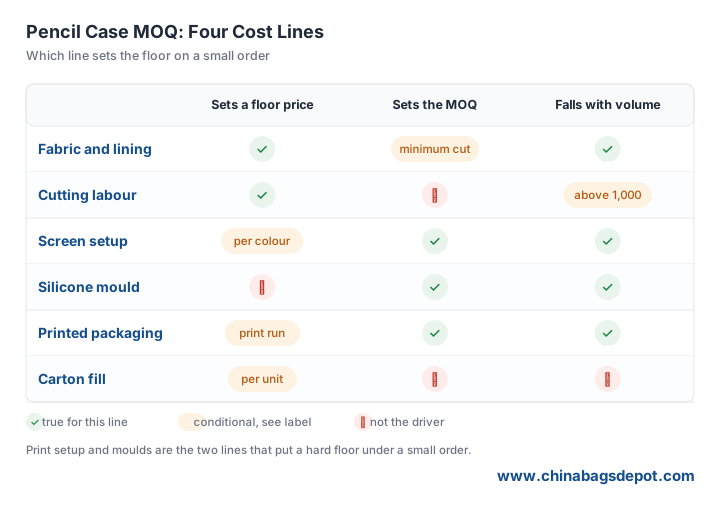
None of this requires the factory to reveal its margin. Four rows, each labelled fixed or variable, is enough to see where the minimum comes from and which lever moves it. Buyers who ask that question at the quotation stage usually end up with a smaller first order and a cleaner second one, because the design has been matched to the quantity instead of the other way round.
Need custom bags for your next project?
Send your bag style, size and print artwork for a quote and a digital proof.
Get a free quote


