Pencil Case Sourcing Calendar: 6 Lead Times to Plan Around
A pencil case order does not run late in production. It runs late at the two or three points where a document or a material has to be approved before the next step can start, and nobody notices until the ship date is three weeks out. The fix is a calendar built backwards from the date the goods must land, with each step owned by a named person and proved by a document.
Count Back From the Landing Date, Not the PO Date
For a pencil case the landing date is usually fixed by something outside the factory: a back-to-school shelf date, a distributor launch, or a trade show. Take that date, subtract the sea transit and the customs clearance window, and you have the date the container must leave. Every other date in the order is derived from that one.
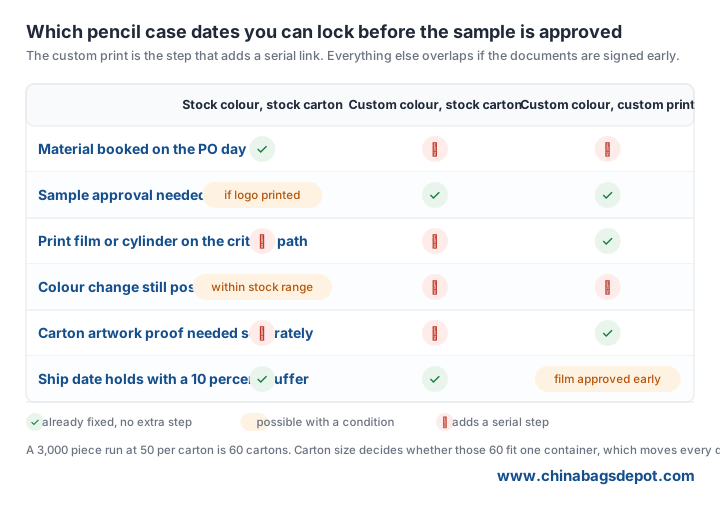
The number that matters is not the longest single step but the longest serial chain. Material booking, print tooling and bulk production can overlap only if the print artwork is approved before the material arrives. If it is not, the chain becomes the sum of all three, and the order finishes late even though every individual step hit its own promise.
The Six Dates That Decide the Order
Material booking. The fabric, the PU, the zipper tape and the lining in the specified colour. If the colour is a stock shade, this is a purchase order. If it needs dyeing, it is a queue, and the queue is what moves when a bigger customer books the same line.
Print film or cylinder. Screen printing needs a film and a screen; heat transfer needs a transfer sheet; a printed or embossed logo on a silicone case needs a mould insert. Each of these is a physical object that has to be made and approved before mass printing starts.
Sample approval. A signed, photographed, physically approved sample with the exact print position and thread colour. Approval by chat message is not approval, and it is the single most common reason a bulk run repeats.
Bulk production slot. The factory commits a line and a date range. This date, not the PO date, determines whether the order is early or late, and it is the date that silently disappears when a buyer asks for a change after booking.
Packing and carton proof. Carton dimensions, barcode, shipping marks, poly bag or display box. A two-centimetre increase in carton height can change the container plan, so this proof belongs weeks before packing, not on the packing day.
Inspection and vessel booking. Book the inspection when the production start date is confirmed, and book the vessel when the carton count is fixed, not when the goods are ready.
Which Dates Respond to Money, and Which Do Not
Buyers often assume every date can be bought. Three can, three cannot. Money reliably shortens print tooling: a film, a screen or a mould insert can be pushed to the front of a queue, and the cost is visible and one-off. Money can also buy air freight, which moves the landing date but not the production date, and on a low unit price item it usually costs more than the order is worth.
Money does not buy sewing capacity. A second line is a scheduling decision the factory makes for its own reasons, and a request to jump the queue is answered with a promise rather than a date. Money also does not shorten sample approval, because that delay sits with the buyer. And it does not shorten material dyeing if the dye house is full.
There is one free lever that buyers forget: substituting a stock colour for a custom one. Most pencil case programmes have two or three colours that carry the design, and a stock shade in the same family removes the dyeing queue entirely from the chain, at no cost and often without a visible difference on the shelf.

Where the Buffer Belongs
Put the buffer at the front, in material booking and print tooling, not at the end before the ship date. A buffer at the end is consumed by every earlier slip and then hides the fact that the order is behind, because the plan still shows a gap. A buffer at the front absorbs the slips while there is still time for the factory to resequence.
A workable rule is ten percent of the serial chain, applied once, at the two steps that depend on a third party: dyeing and tooling. Do not split it across five steps. Five small buffers disappear quietly; one buffer in the right place is visible in the calendar and can be reallocated.
The Calendar Stops That Are Not Yours to Move
Three stops move every pencil case calendar. The Spring Festival shutdown, whose dates shift each year and are announced by each factory, not by a national calendar. The early-summer and early-autumn holiday blocks. And the back-to-school retail window, which is the one that decides whether a late container is worth shipping at all.
For a school-season programme, count back from the retail date, not from the factory ship date. A container that arrives after the shelf reset is not late by two weeks; it is a season late, and the goods sit in a warehouse until the price is discounted. That is the scenario the calendar exists to prevent.
Put the Calendar in the PO as a Table of Days
Five columns, filled in with the supplier before the deposit: step, owner, days, proof document, trigger for the next step. Then check the arithmetic against the container. A run of 3,000 pieces at 50 per carton is 60 cartons, and the carton dimension decides whether those 60 fit one container or need two, which changes the freight date and therefore every date above it.
If you are ordering pencil cases for a school season and want the six dates priced against your landing date, send the quantity, the target shelf date and the print method, and we will return the calendar with the buffer placed where it actually absorbs a slip.
Need custom bags for your next project?
Send your bag style, size and print artwork for a quote and a digital proof.
Get a free quote


