Bag MOQ Reality Check: What 300 Pieces Actually Costs Per Unit
Ask five suppliers for a price on 300 tote bags and you will get five numbers that look comparable and are not. The low quote usually assumed a fabric the mill sells by the roll, skipped the cutting die, and priced the print as if the artwork were already on a screen. At 300 pieces the per-unit price is dominated by costs that do not scale at all, and the only way to read a quote is to separate the lines that scale from the lines that do not.
Why 300 pieces is a different product from 1,000
Below roughly 500 pieces, a bag order stops behaving like a production run and starts behaving like a sample run repeated 300 times. Cutting is done on a table rather than a die press, or on a die that has to be paid for in this order. Fabric comes off a roll that was bought for this order alone, and whatever is left over is charged to these 300 pieces. Print setup is spread over 300 impressions instead of 1,000. None of that is a supplier trick; it is the arithmetic of small volume, and it is why the same bag quoted at 1,000 pieces can look like a different product.
Fabric is sold by the roll, not by the bag
This is the single biggest reason a 300-piece quote looks expensive. Mills quote canvas and polyester by the metre with a minimum length, and a mill's minimum is usually a full roll or a stated number of metres, not the metres your 300 bags need. If your bag consumes 0.6 metres of 10 oz canvas and you order 300, you need 180 metres plus cutting loss; if the mill's minimum is 500 metres, you buy 500 and the surplus sits in the supplier's rack as your cost or as dead stock.

Two ways out. First, ask what the fabric minimum actually is in metres and compare it with your consumption, so you know whether you are paying for 180 metres or 500. Second, move to a fabric the supplier already stocks for other buyers, which removes the minimum entirely and usually costs a little more per metre but far less per bag at this volume. A stock colour in a standard weight is often the cheapest decision on the whole order.
Tooling: screens, dies and embroidery tape
Four tooling items appear on bag orders and each has a fixed cost that does not care how many pieces you make. A screen for screen printing is charged per colour per position, so a two-colour logo on the front and a one-colour line on the back is three charges, not one. A cutting die is charged once and then used for the whole run. A heat-transfer or digital print has a setup charge but no screen. Embroidery needs a tape or a program file, charged once per design.
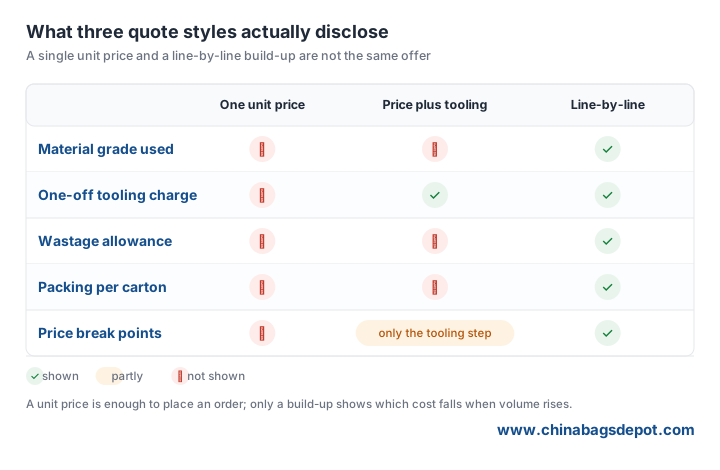
The practical test when comparing quotes is to ask each supplier to split tooling from the unit price. A quote of 2.10 per piece with 90 of tooling and a quote of 1.85 with 400 of tooling are not close at 300 pieces; they invert at 2,000. Write both numbers down before you compare anything else.
Labour, changeover and packing
Sewing a tote is fast; setting up to sew a tote is not. Before the first piece, the line needs the pattern graded, the thread matched, the needle and stitch length set, and the first-off piece approved. That setup is one cost whether you run 300 or 3,000. At 300 pieces it can be a meaningful share of the unit price; at 3,000 it disappears.
Packing follows the same pattern. A carton specification, an inner bag, a hangtag with a barcode and a polybag with a warning label are all one-time design decisions plus a per-piece material cost, and the per-piece material cost only improves when you buy the polybags and hangtags in quantities the supplier can actually discount. Ask how many pieces go in a carton and what the carton measures, because that number sets your freight per bag and is frequently left out of the unit price conversation entirely.
An illustrative build-up for 300 pieces
Take a plain canvas tote, one-colour front print, stock fabric, no die. Assume the supplier quotes fabric at a rate per metre, sewing at a rate per piece, print at a rate per impression plus a screen charge, and packing at a rate per carton. At 300 pieces the screen charge and the first-off approval sit on top of a small number of units, which is why the printed unit price can be well above the unprinted one. Run the same build-up at 1,000 and the fixed lines spread across more than three times as many pieces while the variable lines barely move.
You do not need the supplier's real numbers to use this. Build the sum yourself with their quoted rates, then re-run it at 600 and 1,000 using the same rates. If the unit price barely falls, the fixed costs were never the problem and you are being quoted on a variable-only basis. If it falls sharply, you now know exactly what volume you need to justify.
Getting 300 pieces closer to the 1,000-piece price
Four moves work, and none of them require a bigger order. Use a stock fabric and a stock colour so the mill minimum disappears. Reduce the print to one colour in one position, which removes two screen charges at once. Accept a standard carton and packing configuration instead of a custom one. And ask whether the supplier will run your order alongside another buyer's in the same material, which is the only legitimate way a small run gets a large-run fabric price.
What does not work is asking for a discount on the unit price without changing the specification. The supplier's fixed costs are real, and a lower number at 300 pieces is almost always a lower specification: a lighter fabric, a thinner thread, a heat transfer instead of a screen, or a carton with no inner bag. The MOQ conversation is worth having, but only when the two quotes are built from the same five lines and you can see which line moved.
Need custom bags for your next project?
Send your bag style, size and print artwork for a quote and a digital proof.
Get a free quote


