Pencil Bag Printing: Screen vs Heat Transfer at 3,000 Units
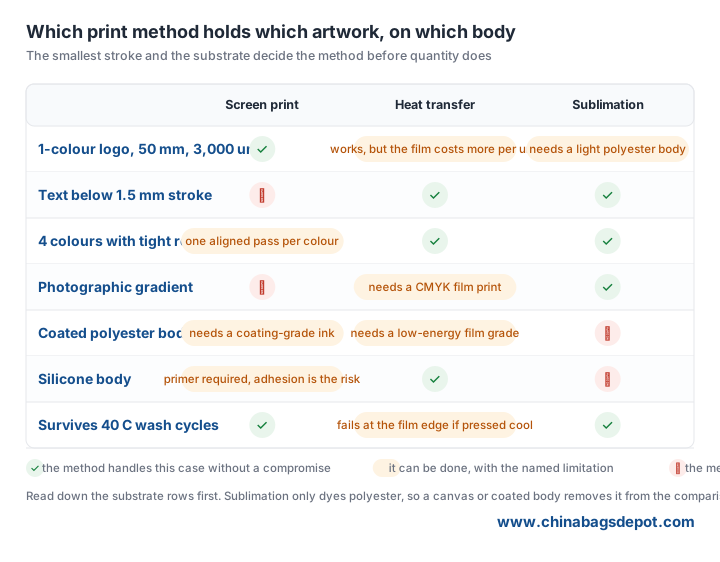
At 3,000 pieces the choice between screen printing and heat transfer on a pencil bag is not settled by price per print. It is settled by two things: how many colours the artwork carries, and how small the smallest stroke is. A one-colour logo at 50 mm behaves the same on both methods and you should buy whichever your factory already runs well. A four-colour illustration with 2 mm lettering does not — it moves the job to heat transfer, and no quantity argument changes that.
This is the reasoning behind that split, the substrate problems that override it, and the checks that show up six weeks after delivery rather than on the sample table.
What each method is doing to the fabric
Screen printing pushes ink through a mesh and deposits it directly on the cloth, one screen and one pass for each colour. Mesh count sets the ink volume: a coarser mesh lays down a thicker film that covers dark canvas, a finer mesh gives a thinner film and sharper edges but lets the cloth texture show through. Each colour is a separate screen, a separate registration against the previous one, and a separate cure.
Heat transfer prints the artwork onto a carrier film or paper first, then presses it onto the bag at around 150 to 160 °C for 10 to 20 seconds. All colours are registered once, on the carrier, where the printer can see them at high magnification. The press then transfers the whole image in a single cycle. The film remains on the bag as a layer, which is why the hand feel differs from screen print and why edge lifting is the failure mode to watch.
Where the cost actually crosses over
Screen printing carries a fixed cost per colour — a screen, a setup, a test print — and a low cost per unit. Heat transfer carries a fixed cost per design, not per colour, and a higher cost per unit because of the film. That arithmetic gives a clean rule: the more colours in the artwork, the earlier heat transfer wins on total cost, because a four-colour screen job pays four setups while a four-colour transfer pays one.
At 3,000 units a one- or two-colour design almost always lands on screen print, since the setup is spread over a long run and the ink cost per bag is small. A four-colour design with tight registration usually lands on heat transfer, not because the transfer is cheap but because the screen version needs four aligned passes and the rejects from misregistration eat the difference. Run the numbers on both quotes including the expected reject rate, not on the print price alone.
The size of the smallest stroke decides more than the colour count
Screen printing has a floor. Ink spreads slightly after it passes the mesh, so strokes under about 1 mm close up, and reversed-out text — light letters inside a dark block — fills in first because the ink bridges the gap. Practical floor for a pencil bag is a 1.5 mm stroke and 6 point type, and even that needs a fine mesh and a printer who will slow the squeegee down.
Heat transfer holds roughly 0.3 mm lines and 4 point type because the image is printed flat on film, where the resolution limit is the printer rather than the cloth. If the artwork contains a school logo with small text, a web address, or a barcode, this single fact decides the method before anything else is discussed.

The bag material can rule out a method before artwork matters
Canvas and 600D polyester take both methods, with different ink systems. Coated polyester needs an ink that keys to the coating rather than to the weave, and a transfer film needs a grade formulated for low-surface-energy surfaces. Silicone pencil cases are the awkward case: ink does not bond to silicone the way it bonds to textile, so the print usually has to be a transfer applied with a primer, or a moulded-in colour change instead of a print at all.
Sublimation is the third option buyers ask about and it has one hard limit — it only dyes polyester, and only light-coloured polyester at that. On a canvas body it does nothing. On a white polyester pencil case it gives a photographic gradient with no film layer and no edge to lift, which is why it wins on full-colour artwork and loses on every other substrate.
What fails after washing, and how to test it before bulk
Screen-printed plastisol on canvas survives repeated washing at 40 °C because the ink film is cured into the weave, and the failure mode is under-curing, not the method. An under-cured print feels tacky, cracks along fold lines, and washes off in patches. The check is a stretch test on the sample: pull the printed area 20 percent and look for cracking at the ink edge, then rub the print with a white cloth for 50 strokes and check for colour transfer.
Heat transfer fails at the edges. Film that was pressed too cool, or pressed over a seam, lifts at a corner within a handful of washes and then peels progressively. Press the sample through five wash cycles at 40 °C with a normal detergent load and inspect the perimeter at magnification; a lifted corner on the sample is a lifted corner on 3,000 bags. Also check the print over any zip seam or binding, because the film cannot conform to a step in the surface.
Write the method, the mesh and the cure into the order
A purchase order that says "print logo on front" leaves the method, the ink and the cure to whoever runs the line that day. State the method, the number of colours, the smallest stroke in the artwork, the cure temperature and dwell, and the wash test the delivery has to pass. Then keep one printed sample per colourway, tagged with the date and the press settings, as the reference for the next run.
If the artwork is still in flux, settle the stroke size first: it is the only variable that can force a method change after the quote is signed. Browse the pencil bag category to see which bodies the current range prints on, and send the artwork file with the smallest text called out before asking for a price.
Need custom bags for your next project?
Send your bag style, size and print artwork for a quote and a digital proof.
Get a free quote


