Non-woven vs Canvas Promotional Totes: Cost Per Use
If the bag is handed out at a three-day trade show, non-woven wins and nobody carries it fifty times. If it goes into a supermarket basket every week for a year, canvas wins even at three times the unit price, because the denominator in tote bag economics is uses, not pieces. The crossover is arithmetic, and it is the one number a promotional buyer can actually control before placing the order.
Cost per use is the unit price plus print setup, divided by the number of carries you can honestly expect. Two quotes at the same quantity rarely differ by more than the material; two quotes at different quantities differ by everything. Below is how to make the comparison hold.
Do the division before you look at the sample
Write down three numbers: your order quantity, the total landed cost including print setup and freight, and the expected carries per bag. Then divide. A screen charge of one colour on one side is a fixed cost; at 500 pieces it lands on every unit, at 5,000 it nearly disappears, which is why a supplier quoting 1,000 non-woven against 500 canvas has already decided the answer for you.
The second number is the honest one. A conference tote that leaves the hall and goes into a hotel wardrobe has one confirmed use. A grocery tote that replaces a plastic bag at the same shop every Saturday has fifty-two. Use the lower figure, not the flattering one, and the material choice usually makes itself.
What the two materials actually are
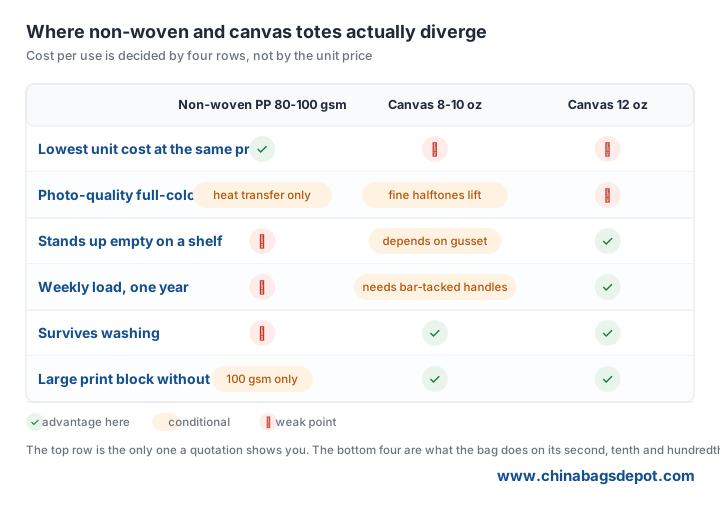
Non-woven promotional bags are spunbond polypropylene, sold by weight per square metre. 80 gsm is the common give-away grade and feels like a stiff sheet; 100 gsm has enough body to stand on a counter but costs meaningfully more per piece. It is a plastic fabric: it does not absorb water-based ink the way a woven textile does, it does not soften with washing, and it takes a crease permanently.

Canvas is woven cotton, sold by weight per square yard. 8 oz is a light tote that folds into a pocket, 10 oz is the retail default, 12 oz is a structured bag that stands up empty. The relevant difference is not strength alone but how the fabric behaves across a hundred cycles: cotton abrades, fades and softens, and it keeps carrying.
The print method sets a ceiling on uses
Screen printing is the default on both materials and the most durable option on either. It puts ink into the surface, survives abrasion, and holds up to washing on cotton. Heat transfer gives you photographic detail, which is why it is common on non-woven, but the film sits on top of the panel and lifts at the edges after repeated folding.
Two print decisions change the bag more than the colour count. Coverage: a full-bleed block on 80 gsm non-woven stiffens the panel and makes the bag crease along the print edge. Placement: a print that runs under the handle anchor will crack where the handle pulls, which is exactly where a buyer looks first. Ask for the print area as a dimensioned rectangle, not as a percentage.
Handles and seams decide how many carries you get
On non-woven, the handle attachment is the failure point, and the two common builds are far apart. An ultrasonically welded handle on 80 gsm separates after a handful of heavy loads; the same handle stitched with a box-X through a reinforced patch lasts the life of the panel. If the quote does not say which, assume the cheaper one.

On canvas, the equivalent field is bar-tacking: the short dense stitch run that locks a webbing handle to the body. Un-bar-tacked canvas handles pull out from the top edge, usually at the corner, and the bag fails while the fabric is still sound. Bottom seams matter for the same reason; a single-stitch bottom on a bag that will carry tins and bottles is a decision, not an economy.
Trade show or weekly shop: two different bags
For a trade show, the bag has one job in a crowded hall: be legible at two metres and light enough that a visitor keeps carrying it to the next booth. 80 gsm non-woven with a single-colour print on one side does that at the lowest cost per unit, and the low confirmed-use count means an expensive fabric earns nothing. Spend the difference on print size, not on material.
For a retail or supermarket programme, the bag is a repeated object and the arithmetic flips. A 10 oz canvas tote with a gusset, a reinforced bottom and bar-tacked webbing handles will carry a weekly shop for years, and the cost per use falls below the non-woven alternative long before the year is out. If the programme also uses the bag as a paid item on a shelf, add a flat bottom so it stands, and specify the print as a two-sided layout because the second side is seen by everyone behind the customer.
Write the enquiry so both quotes are comparable
Send one specification with a material slot, and ask for both options at the same quantity, same print area, same number of colours and same handle build. The seven lines that must be filled in: fabric weight, panel size, gusset depth, handle material and attachment, print area in centimetres, colours and sides, and pieces per carton.
Then ask one question that sorts serious suppliers from traders: what is the handle attachment, and can you show a photo of the inside of the top seam. A supplier who answers with a stitch pattern and a photo is quoting a product. A supplier who answers "strong handle" is quoting a price.
Need custom bags for your next project?
Send your bag style, size and print artwork for a quote and a digital proof.
Get a free quote

