Pencil Case Payment Terms: 30/70, LC and Trade Assurance
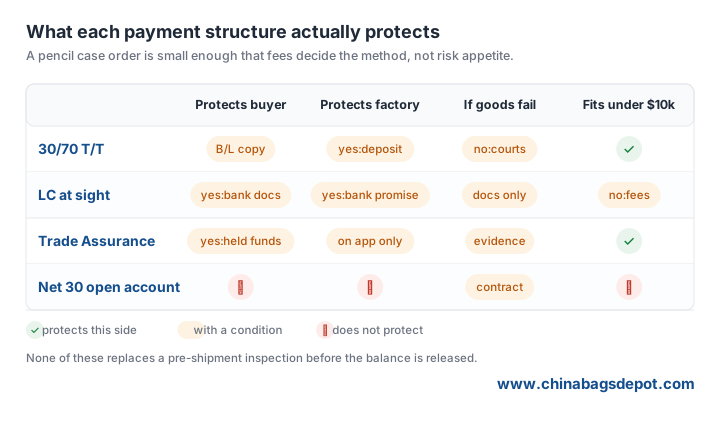
On a pencil case order the payment method is usually decided by the fee schedule, not by risk appetite. A 3,000 piece run at a unit price in the low single dollars is a five figure order at most, and the paperwork for a letter of credit can cost more than the price difference between two factories. That does not mean payment terms are unimportant; it means the structure has to match the size of the order and the stage of the relationship.
Why a small sewn order is a different payment problem
Pencil cases sit at the low end of bag pricing, which changes three things. Order values stay small, so a fixed bank fee is a real percentage of the goods. Production is short, often a few weeks, so the window in which the deposit has to fund materials is narrow. And the products are usually screen or heat transfer printed with a school or brand logo, which means the factory has to buy fabric, zip, lining and print setup before it can ship anything. Those three facts point to a simple 30/70 structure for most orders, with escrow as the bridge for a first order and a letter of credit reserved for the cases where a bank has to stand behind the paperwork.
30/70 T/T: what the 30 and the 70 each buy
The deposit is not a goodwill payment. It is the factory buying material: fabric, zip tape, sliders, lining, thread and the print or transfer setup that is specific to your artwork. On a sewn product the material commitment happens early, which is why factories ask for 30 percent rather than 10. The balance of 70 percent is normally released against a copy of the bill of lading, after the goods are loaded.

Two details decide whether that structure protects you. The first is what counts as loading. Paying against a bill of lading copy means paying before you have seen the goods, so the balance should be tied to a passed pre-shipment inspection rather than to the sailing date. The second is the quantity tolerance. Bulk sewn goods are commonly invoiced with a tolerance of a few percent either way, and the balance should be calculated on the actual shipped quantity, not on the ordered quantity, or you will argue about a rounding difference at the end of every order.
On the deposit side, ask for the material purchase to be visible. A factory that sends a photo of the fabric roll with your order reference, and the print setup sheet, is a factory that has actually started. That single request filters more problems than any clause.
LC at sight: when the bank paperwork earns its fee
A letter of credit moves the risk from the trading relationship to a document set. The bank pays against compliant documents, not against good pencil cases, so an LC protects you from a factory that takes the deposit and disappears, and from a shipment that never happens. It does not protect you from goods that arrive wrong, because the documents can be perfectly in order while the cartons are not.
The cost structure is what rules it out for small orders. Opening an LC carries a fixed fee plus a percentage, amendment costs extra, and every discrepancy you allow in the documents becomes a negotiation while your goods sit at the port. On a five figure order those fees are a meaningful share of the goods value. On a larger order, or a first order with a factory nobody in your company has paid before, the arithmetic changes and an irrevocable LC at sight becomes reasonable.
If you do use one, the terms have to be exact: irrevocable, at sight, shipment date, whether partial shipment and transhipment are allowed, the full document list including packing list, invoice, bill of lading and any certificate of origin, and a clause stating which side pays bank charges outside the issuing bank. Vague wording in that block is the usual source of discrepancies.
Trade Assurance and escrow: what is actually covered
Platform escrow is the practical answer for a first pencil case order. Funds sit with the platform and release on agreed milestones, usually deposit on order confirmation and balance after shipping documents or after a passed inspection. The coverage has one condition that buyers miss: it applies to orders paid through the platform. Pay the deposit to a bank account outside the order and the protection is gone, whatever the platform page said.
The other limit is evidence. Disputes are decided on documents and photos submitted inside the platform, so the inspection report, the approved sample photos and the specification sheet need to exist before the problem. A dispute opened with a chat log and no signed sample is a weak dispute. Treat the platform record as the case file from the first message.
Clauses that decide whether the terms work
Four clauses do most of the work. Bank charges: state who pays, because on a small wire the charges can eat a noticeable slice of the value and both sides will assume the other pays. Currency and exchange: agree the invoicing currency and whether the rate is fixed at order or at payment. Balance trigger: pre-shipment inspection passed, or documents presented, and what happens if the inspection fails. And the failure procedure: rework and re-inspect at whose cost, or shipment with a price adjustment, agreed in writing before production rather than after a rejection.
Tooling and print setup are usually quoted separately and are not refundable, which is worth separating on the invoice so the goods value and the setup cost do not get blended into one number that neither side can reconcile later.
A workable structure for first and repeat orders
For a first order, use platform escrow or a 30/70 wire with the balance against a passed inspection, and keep the order value small enough that a total loss would be survivable. For a second and third order with the same factory, 30/70 by wire is efficient and the inspection can move to a sampling basis. Once a factory has shipped three clean lots, discussing 20/80 or a small credit line is reasonable, and it is the factory that should offer it, because that offer is a statement about their cash position and their confidence in the relationship.
Send the order value, the print or material complexity and whether this is a first or repeat order, and we will confirm which payment structure fits and what the balance will be released against.
Need custom bags for your next project?
Send your bag style, size and print artwork for a quote and a digital proof.
Get a free quote


