Leather Satchel Hardware: 5 Failure Points Buyers Miss
Hardware is where a satchel gets returned, not the leather. The turn lock loses its spring, a rivet tears through the strap anchor, or the ring holding the shoulder strap deforms until the bag hangs crooked. All five of the failures below are visible on a sample in one bench session, and all five are cheap to fix before a bulk run, which is why they are worth testing in this order rather than trusting a photo of the finished bag.
Why Hardware Fails Before the Leather Does
Leather and PU both fail gradually: they scuff, soften and crease, and buyers accept all three as normal wear. Hardware fails abruptly. A lock that opened smoothly for months suddenly will not catch, and the bag is unusable that day. The reason is that hardware carries load through small metal-to-metal contacts, and every one of those contacts has a tolerance stack: plating thickness, spring temper, rivet burr, ring gap. When the stack drifts across a production run, the failure appears in the field rather than on the bench.
The practical consequence for a buyer is that hardware should be approved by function, not by finish. A gold-plated lock photographed well proves nothing about whether the spring returns. What proves it is a pull, a cycle count and a look at the plating after both.
Turn Lock and Press Lock: The Spring, Not the Plate
A turn lock fails in three ways, in this order: the spring loses tension so the tongue no longer snaps home, the tongue wears a groove in the strike plate so the lock needs a wiggle, and the plating on the tongue flakes where it rubs. The first is invisible on a new sample and appears after a few hundred cycles; the third shows up as a bright scratch on the plate.
Test it with a cycle count rather than a look. Open and close the lock 200 times by hand, then check three things: the tongue should still snap with an audible click without being pressed, the key or knob should turn without catching at the halfway point, and the strike plate should show a polish mark rather than a cut groove. A groove deeper than the plating thickness means the alignment is off, and the whole run will wear the same way.
Rivets at the Strap Anchor: The One That Tears the Leather
The rivets holding the strap anchor are the highest-stress fasteners on the bag, because the full carried weight passes through two small points. Failures are not usually rivet breakage; they are the rivet pulling through soft material. On PU and corrected-grain leather the anchor can tear before the rivet deforms, and the tear starts as a small crescent at the top rivet.
Two checks settle it. First, hang a load equal to the intended carry weight from the strap for a full minute on a sample and watch the leather around the rivet head, not the rivet. Any visible stretch ring means the backing is too thin. Second, cut one sample anchor open: there should be a washer or a reinforcing strip behind the material. Rivets set straight into a single layer of PU will hold at the bench and tear in a year of daily use.
D-Rings and Strap Rings: Coating First, Deformation Second
The ring is the part that moves, so it wears from the inside out. On a plated ring the coating goes first, exposing base metal that oxidises and stains the strap end. On a thin ring the shape goes second: the ring opens into an oval and the strap clip starts to twist. Buyers notice the stain before they notice the oval, so plating adhesion is the check that protects the review score.
Rub the ring against the strap clip by hand for a minute, then look at the contact point under a light. Plating that has already gone dull or shows a colour change at the rub point will not survive a season. Then load the ring and measure its width across the opening before and after: a ring that opens more than a millimetre under the rated load is too soft for the bag.
Magnetic Snaps and Handle Studs: The Two Quiet Failures
A magnetic snap does not break; it stops holding. The magnet keeps its strength but the pocket that seats it loosens in the lining, so the flap closes with a soft feel and opens in a bag. Check it by loading the flap with a light pull and then shaking the bag upside down over a table: a snap that releases under its own flap weight is undersized for the bag size.
Handle studs fail the same quiet way. The stud does not pull out, it rotates in its hole, and after a few months the handle sits at an angle. Twist each stud by hand on the sample. Any rotation at all means the stud is set into the lining rather than through a reinforced base, and the handle will loosen with use.
One Bench Session, Five Checks
Run the five checks in a single sitting on two samples, one from the start of the run and one from the end, and record each result against the same criteria. The matrix below shows which check actually produces a signal for each part, so nobody wastes a cycle count on a rivet or a corrosion check on a magnet.
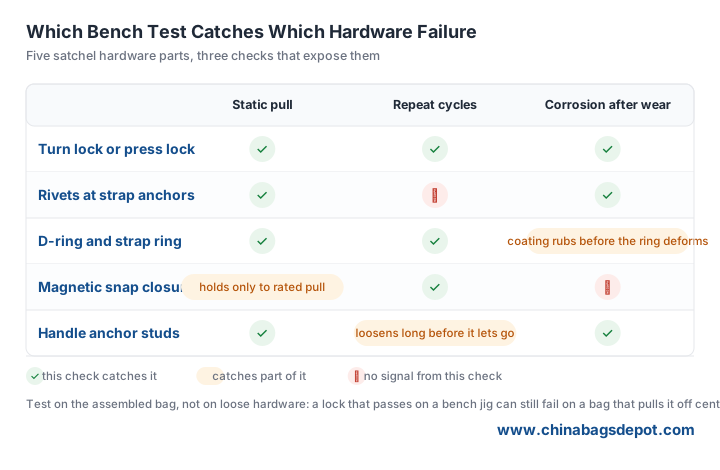

Write the criteria into the order before the run starts: 200 lock cycles without a miss, no stretch ring at the strap anchor under the rated load, ring opening within 1 mm, and no rotation at the handle studs. Those four lines cost nothing to add and they turn a subjective argument about quality into a pass or fail on the sample.
Send the bag style and the hardware list, and we will quote the satchels range with those four checks written into the sample approval, so the bulk run is measured against the same criteria as the sample you signed.
Need custom bags for your next project?
Send your bag style, size and print artwork for a quote and a digital proof.
Get a free quote


