Backpack Foam Density: Why 25D Straps Fail a School Year
Most school backpack straps are made from 25 kg/m³ foam, and most of them are flat by the second term. The number is not a quality label — it is the density of the foam in kilograms per cubic metre, and at 25 it is low enough that a loaded strap compresses past recovery. Upgrading to 30 or 35 costs a little per piece and is the difference between a strap that still has shape in June and one that has become a webbing ribbon.
Why 25D Foam Fails a School Year
A shoulder strap is a foam slab wrapped in fabric and stitched to webbing. Every time the bag is picked up, the foam under the strap is compressed by the bag's weight, and every time it is put down, the foam is asked to spring back. Low-density foam springs back less completely each cycle. After a few thousand cycles the strap has lost thickness permanently, the load concentrates on the webbing edges, and the bag starts to cut into the shoulder — which is the complaint buyers report as "uncomfortable", not as "foam failure".
The failure is invisible on a sample because it is cumulative. A 25D strap feels perfectly firm in the showroom, which is exactly why the decision has to be made on a test rather than on feel.
What the Density Number Actually Measures
Density (25D, 30D, 35D) is mass per volume. It tells you how much material is in the foam, not how hard it feels. Firmness is a separate property, usually specified as indentation load deflection, and the two can move independently: a 25D foam can be formulated to feel firm on day one and still collapse, while a 30D foam can feel soft and hold its thickness for years.
That is the trap in sample approval. If the buyer squeezes the strap and says "this feels right", they have approved firmness and said nothing about density. Ask for both numbers in writing, and ask which one the factory controls on the production line.
Check 1: Caliper Under Load
Measure the strap foam thickness at three points with a caliper, note it, then hang a 10 kg weight from the strap for 24 hours with the strap looped over a bar so the foam is loaded the way a shoulder loads it. Measure again at the same three points. A 25D strap typically loses about 1 mm and does not come back; a 35D strap returns to within a few tenths.

This is the cheapest check in the list and the one that correlates best with what a parent complains about. Do it on three straps, not one, because foam slabs vary across a bun.
Check 2: Compression Set
Compression set measures how much thickness a foam loses after being held squashed and then released. The standard method for flexible polyurethane foam holds a sample at 50% deflection for 22 hours, releases it, and measures recovery after a settling period; the same test can be run at an elevated temperature to accelerate what a hot car does to a bag left inside it.
Ask the factory for the compression set figure at the density they are quoting, and ask whether it was run at room temperature or at elevated temperature. A 25D foam can look acceptable at room temperature and fail the warm version, which is the condition a school bag actually lives in.
Check 3: The Cut Edge and the Backing
Cut a strap open along its length. The foam should be a closed, even cell structure with no voids and no visible density gradient from face to core. Loose, crumbly cell structure at the cut means the bun was badly mixed, and that strap will shed foam into the fabric and flatten faster regardless of the density printed on the spec sheet.
Look at the backing too. Foam laminated to a stiffener board holds its shape far better than foam stitched straight to webbing, because the board spreads the load across the strap width instead of letting it concentrate under the shoulder point. If the sample has no backing and the density is 25D, the strap has nothing holding its shape.
Check 4: Flex Cycles at the Strap Bend
The strap bends at the same place every time the bag is put on — at the top of the shoulder — and that is where foam breaks down first. Bend the strap through 180 degrees at that point 5,000 times by hand or with a simple jig, then re-measure thickness and look for a crease line that does not flatten out.
A 35D foam survives this with a crease that recovers; a 25D foam develops a permanent fold that becomes a hard edge. This test takes about half an hour and settles the argument faster than any spec sheet discussion.
No single check proves a strap will last a school year, and the matrix below shows why: each test reaches a different property, and a foam can pass one while failing the next.
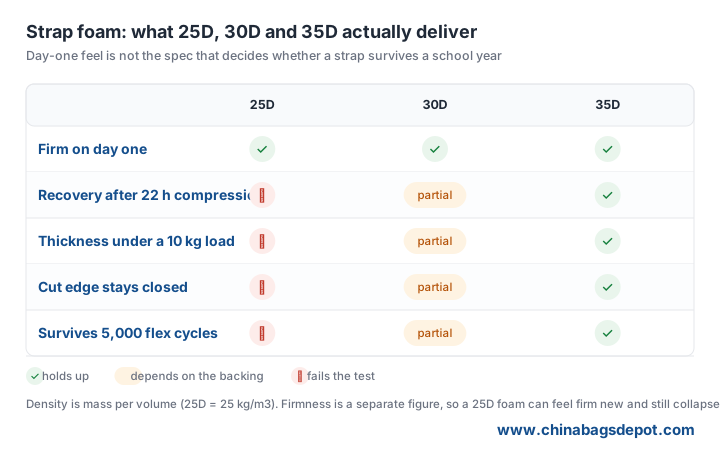
When you specify, put the density, the compression set figure and the backing construction in the same line of the purchase order. A supplier who is told only "good quality straps" will quote 25D, because that is the default and it is the cheapest way to hit the price.
For a school program, ask for school backpacks with 30D or 35D strap foam and a stiffener backing, and request the four results above on a pre-production sample — they take one afternoon at the factory and remove the most common return reason in this category.
Need custom bags for your next project?
Send your bag style, size and print artwork for a quote and a digital proof.
Get a free quote


