Cabin-Size Travel Backpack: 4 Airline Limits to Design Around
Cabin-size is not a volume, it is three dimensions and a weight, and every airline sets its own. A 40-litre backpack that boards a Lufthansa flight at 55 x 40 x 23 cm gets refused on easyJet at 45 x 36 x 20 cm, and the same bag fails Ryanair's personal-item gauge at 40 x 20 x 25 cm before anyone looks at its litre rating. Designing a travel backpack for a retailer means picking which of those gauges the pattern has to pass, then building the bag so it passes when it is full, not when it is empty.
The three dimensions that actually decide boarding
Published cabin limits cluster into three tiers, and almost every carrier sits inside one of them. Numbers move, so treat these as the shape of the problem rather than a fixed table, and re-check the carrier's own page before a program is signed off.
- Full-service cabin bag: around 55 x 40 x 20 to 23 cm, which is the IATA recommendation of 55 x 40 x 20 with a few carriers adding depth. Weight limits of 7 to 10 kg are common.
- Low-cost cabin bag: around 45 x 36 x 20 cm on easyJet, 55 x 40 x 20 on Ryanair's paid cabin bag. Depth of 20 cm is the constant, and depth is where backpacks fail.
- Personal item: 40 x 20 x 25 cm on Ryanair, 45 x 36 x 20 on others, often with no weight allowance beyond what fits under the seat.
The lesson for a pattern maker is that depth, not length or height, is the binding constraint. A backpack is 20 cm deep when it is packed with a laptop, a dopp kit and a change of clothes — and 26 cm deep when someone adds a pair of shoes. Design the depth to hold the volume you are promising, and the front pocket becomes the first thing that has to be flat.

What each tier means for a pattern
Start from the tightest gauge the customer sells into and work outwards. A bag built to 45 x 36 x 20 cm will pass the full-service cabin test with room to spare; a bag built to 55 x 40 x 23 cm will never pass the low-cost one, no matter how soft the fabric is, because the frame and the laptop sleeve set the depth.
Three pattern decisions follow. First, put the laptop sleeve against the back panel and size it for a 15-inch device, about 34 x 24 cm, so the sleeve does not push the depth out. Second, make the front compartment a flat zip pocket rather than a box pocket; a box pocket adds depth the moment it is loaded. Third, keep the base gusset narrow — 12 to 14 cm at the base with the load above it — so the bag's centre of gravity sits close to the wearer's back and the silhouette stays rectangular instead of ballooning.
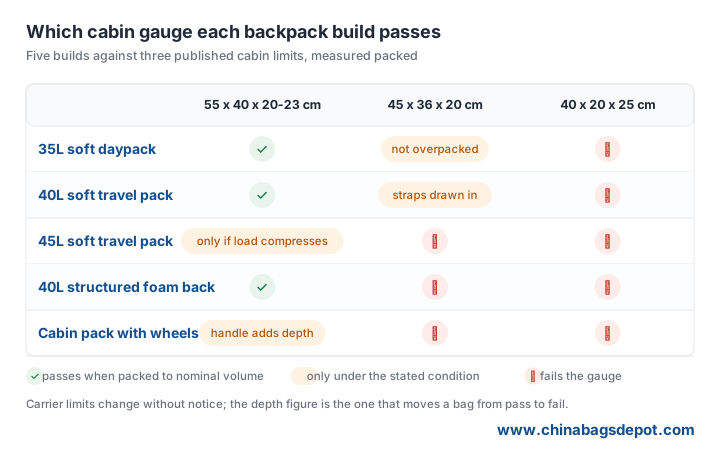
Compression straps are the cheapest way to buy tolerance: two side straps that pull the loaded depth from 24 cm to 20 cm turn a bag that fails one gauge into one that passes, as long as it is sold as "compress before boarding" rather than as a guaranteed fit.
Where a soft backpack wins and where it fails
A soft canvas or polyester body with no internal frame compresses, and that compression is worth more than two centimetres of advertised volume. It also survives being shoved under a seat, which a hard-shell trolley does not. That is why cabin backpacks outsell cabin trolleys in the under-100-dollar gift and corporate segment.
The failure modes are predictable. A structured foam back panel holds the shape and looks expensive on a shelf, but it fixes the depth at whatever the panel plus load measures, so a structured pack behaves like a box. Wheels and a telescopic handle add 4 to 6 cm of depth and about a kilogram, which is why wheeled cabin bags have their own gauge. And a bag with a padded laptop compartment, a shoe pocket and two bottle pockets exceeds 20 cm depth in every direction at once.
Four numbers to put on the spec sheet
A cabin backpack spec sheet that a factory can build to needs four measurements, all taken on a packed bag:
- Packed external dimensions in centimetres, stated as length x height x depth, measured with the bag filled to its nominal volume.
- Empty weight in grams, because the carrier's 7 kg allowance includes the bag.
- Nominal volume in litres, defined as the main compartment only — say so, or the retailer will quote the total including every pocket.
- Compressed depth with the side straps fully drawn, which is the number that decides whether the bag passes a sizer frame.
Add the laptop size the sleeve is cut for and the gauge the bag is designed to pass. Those six lines end most arguments before a sample is even sewn, because they force the retailer to name the carrier tier instead of asking for a bag that "fits everywhere".
Testing the bag against a sizer frame
Airport sizer frames are open boxes, and a bag either drops in or it does not. Reproduce that at the factory: build a plywood frame to the tightest gauge in the brief, pack three samples to nominal volume, and drop each one in. A bag that needs to be pushed is a bag that will be refused at a gate where the agent is in a hurry.
Then weigh it. A 1.4 kg empty bag leaves 5.6 kg of contents against a 7 kg allowance, which is one laptop and a change of clothes — a number the retailer should print on the hangtag, because the customer who overpacks blames the bag, not the airline.
Finally, pack and unpack the sample twenty times: zips that fail, webbing that stretches and buckles that slip show up in that loop, not in a photo. The review after a failed trip is written by the customer who will not buy the next model.
Send the carrier tier, the gauge the bag must pass and the volume you want to advertise, and the pattern can be built to the tightest of the three rather than guessed at. Travel backpacks for bulk orders are quoted per project; request a sample and a quote with your quantity and target market.
Need custom bags for your next project?
Send your bag style, size and print artwork for a quote and a digital proof.
Get a free quote


